Astro ecommerce: a fast storefront on your existing shop.
Astro ecommerce means Astro takes the storefront, while catalogue, cart and checkout stay in a commerce engine like Shopify, Saleor or Medusa.
A storefront, not a shop system
Inventory, price calculation, tax and payment stay in the commerce engine. Astro renders the surface.
Static where it can be
Catalogue and content pages are prerendered, cart and account run as on-demand routes.
Storefront plus back office
We come from web development and from e-commerce process consulting: order processing, ERP, shipping.










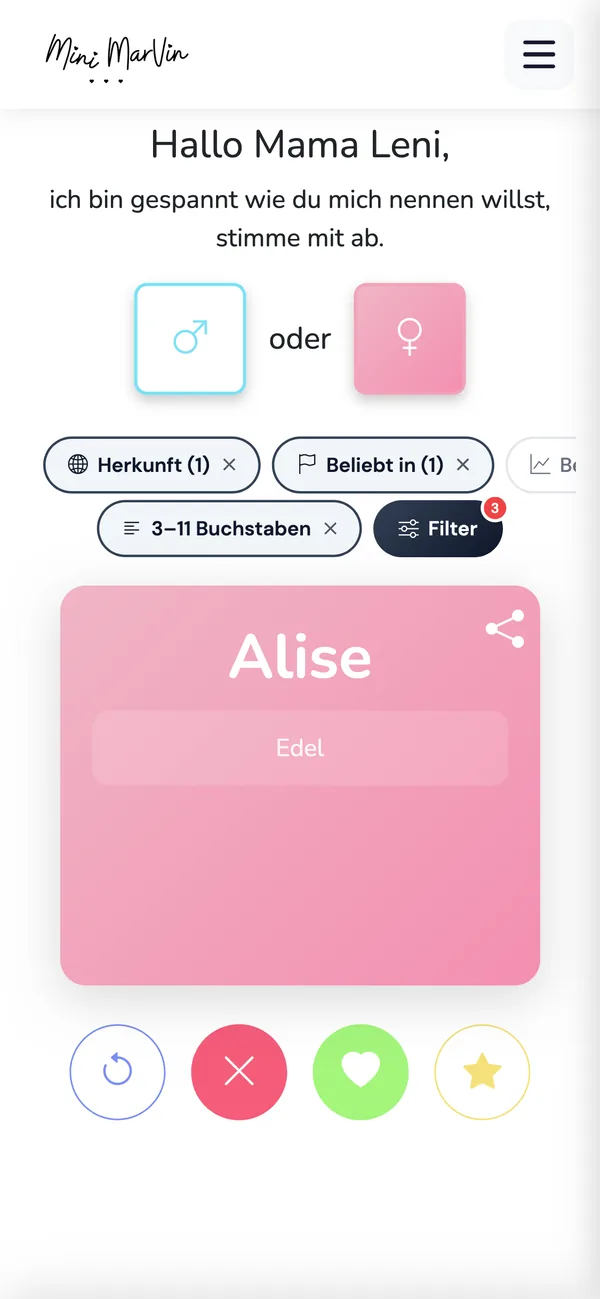
Our own products, live in the browser.
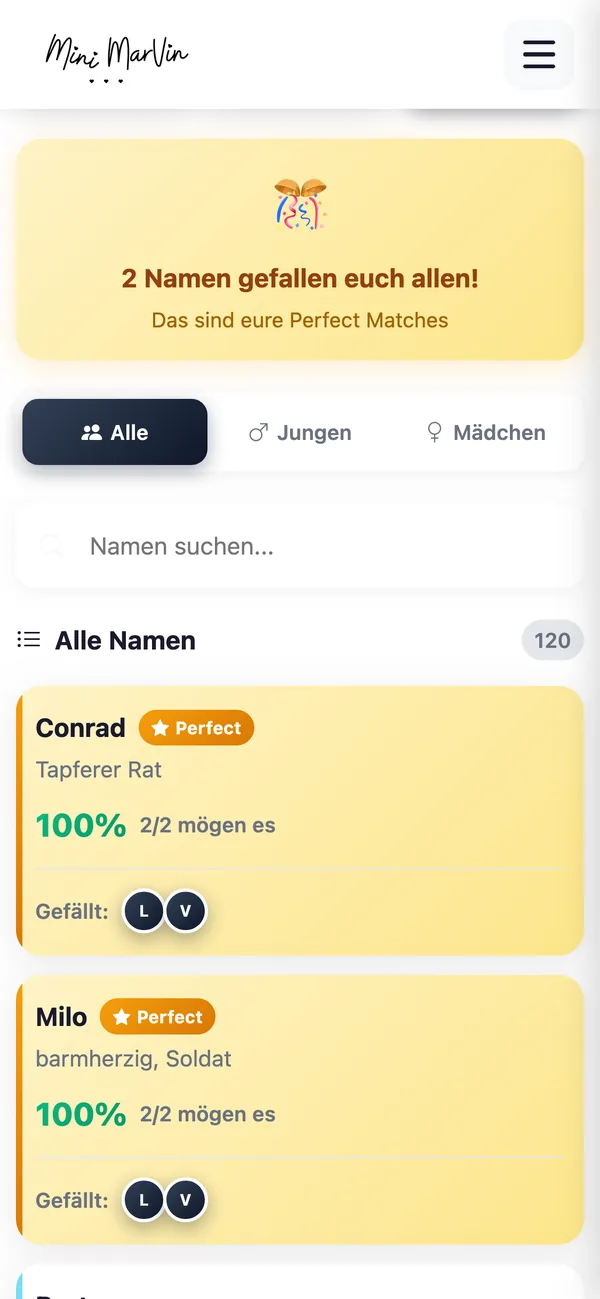
Screenshots from Mini Marvin, our own progressive web app running in the browser.
Swipe baby names instead of scrolling
Mini Marvin is our progressive web app for finding baby names: swipe through 10,000+ first names right in the browser, no app store needed.

Three ways to sell with Astro.
-
Headless commerce with Astro
Your commerce system stays the engine for catalogue, inventory, prices and checkout. Astro pulls the data over the API and renders the shop in front.
Web developmentMore on this
Common with Shopify, Saleor, Medusa or commercetools, and we connect to what you already run. The checkout stays with the vendor, where payment, fraud checks and tax logic belong.
-
A light checkout on the content
Products live as typed content in the repository, while payment and order handling go to a provider such as Stripe or Snipcart.
Content collectionsMore on this
That suits manageable catalogues without a jungle of variants: makers, courses, technical books, spare parts. Much less technology to operate, and the cost does not scale with the catalogue.
-
Content first, selling attached
A magazine, a brand or a specialist portal where the shop is a small part. Content carries the visibility and the sale hangs off it.
Headless CMSMore on this
Content comes from the repository or from a headless CMS. If your team would rather work fully visually without a repository, our Webflow work is the better proposal.
-
What Astro contributes technically
Category, product and content pages are prerendered and served from the CDN. Cart, account and search get on-demand rendering per route.
More on this
Personalised elements such as a cart counter render as server islands through server:defer, without blocking the cacheable shell. Image optimisation is built in and infers dimensions, so the layout stays still while images load. Images from third-party CDNs must be allowed in the configuration.
-
Content by chat, product data never
Because the content model is typed and schema-validated, an AI agent can write into it: campaign copy, a guide article, an image swap.
More on this
Every change becomes a commit with preview and rollback. Prices, stock and variants deliberately stay out of it, because they have exactly one source. More on editing your website by chat, evidenced by our own WhatsApp AI agent.
Storefront, checkout or back office?
Describe in three sentences what you sell, where, and what hurts. You hear which pattern fits.
When an Astro storefront fits.
The right-hand column wins in our first calls more often than an agency page should admit.
Astro as a storefront fits when …
The content around the product helps decide the sale.
- Your catalogue is manageable and stable, from dozens up to a few thousand items.
- Your brand sells through content: guides, lookbooks, use cases, comparisons.
- Your marketing team assembles landing pages from blocks, without a developer queue.
- Your shop is small and a full shop system would be oversized.
A platform or custom software fits better when …
Then we recommend the other route and build it ourselves.
- Your catalogue is deeply personalised, with customer prices, tiers and restricted ranges. That is what custom software is for.
- You need complex faceted search across tens of thousands of variants with live stock.
- Your current storefront converts well. Then we would rather work on conversion rate optimization.
- Your problem sits behind the sale, in orders, stock and shipping. Then the work starts in process consulting.
How your Astro ecommerce project runs.
First assessment
Catalogue, sales channels, systems and editorial routine. Then we say which pattern fits.
Content model and architecture
Which data comes from the commerce system and which routes stay prerendered.
Design and components
Product card, variant picker, filters, gallery and campaign modules as a block library.
Build
Integration, product and category routes, content, images, search. Islands get a loading priority.
Launch with an SEO net
URL inventory, one-to-one mapping, 301 redirects, product markup checks, monitoring in the first weeks.
Astro and ecommerce: frequently asked questions.
We sell on Shopify and the shop works. Is an Astro storefront worth it?
Often it is not. If your storefront converts and load times are fine, a move is risk without return. It pays off at concrete limits: a theme groaning under apps, content and shop in separate worlds, or landing pages that need a developer.
What does headless commerce with Astro mean?
The visible storefront is separated from the commerce system. The platform serves data and order handling through an API while Astro builds the front end. You gain design freedom and give up a finished theme.
Our catalogue has 12,000 items. Will the build take forever?
That question decides the architecture. Astro prerenders everything by default, which becomes a brake on very large or fast-changing catalogues. Individual routes then get on-demand rendering while categories and content stay static. We set the line by your rate of change.
What happens to our checkout?
It stays where it is. Payment handling, fraud checks, tax logic and legal requirements meet in the checkout, maintained and certified at the vendor. Astro takes everything in front of it: category, product, comparison, guides and the cart view.
How do you protect our product rankings?
With a sequence: an inventory of every URL including filter and query variants, ranking and backlink analysis, one-to-one mapping, 301 redirects, metadata and product markup checks on staging, sitemap and monitoring. Movement in the first weeks stays normal.
How long does a project take, and what does it cost?
A storefront on an existing commerce system: eight to fourteen weeks. A content site with a light checkout: four to eight weeks. With several languages, B2B logic or a data migration: sixteen weeks and beyond. The cost drivers are on Astro development cost.
Further reading in the Astro cluster.
The technical base, the system choice and the route there:
Rethink the storefront, or check it first?
Tell us what you sell and where. You also hear when your current shop should stay as it is.
Start a storefront project.
Briefly describe what you sell, on which system, and where it hurts.
We usually reply within 24 hours.
Remote and on site in Germany, Austria and Switzerland. International projects on request.
Related services.
E-Commerce Process Consulting
Order intake, ERP integration, picking, packing and shipping.
Learn moreAmazon Seller Central Consulting
Marketplace processes and integration into ERP and shipping, without account management.
Learn moreCustom Software Development
When a configurator or B2B portal turns the storefront into an application.
Learn more